I arrived in Córdoba an hour late, with a backpack, a carry-on, and half a plan. The train from Granada was delayed, the way things get delayed in southern Spain: no rush, no explanation, nobody particularly bothered.
It didn't matter. I had an afternoon.
The Jewish Quarter
First was the Synagogue. One of only three medieval synagogues still standing in all of Spain. It's small, a single room, but when you think about what it means that it's still there after the expulsion of 1492, after time, after everything, size stops mattering.
A few meters away, the statue of Maimonides. Moshe ben Maimon, born in Córdoba in 1138. Physician, philosopher, rabbi. He wrote the "Guide for the Perplexed" and served as Saladin's personal doctor in Egypt. One of the most important thinkers in Jewish history, born on these streets.
The Calleja de las Flores is a three-meter-wide alley with flower pots. You walk through it in thirty seconds. The point is the photo: the narrow street, the flowers, and the Mezquita tower peeking out at the end. It is what it is.
The Roman Bridge
331 meters over the Guadalquivir. Built in the 1st century BC. It's two thousand years old. Roman legions crossed it, Arab armies, Christian kings.
Guadalquivir comes from the Arabic "al-wadi al-kabir" — the great river. The same one that flows through Seville and empties into the Atlantic.
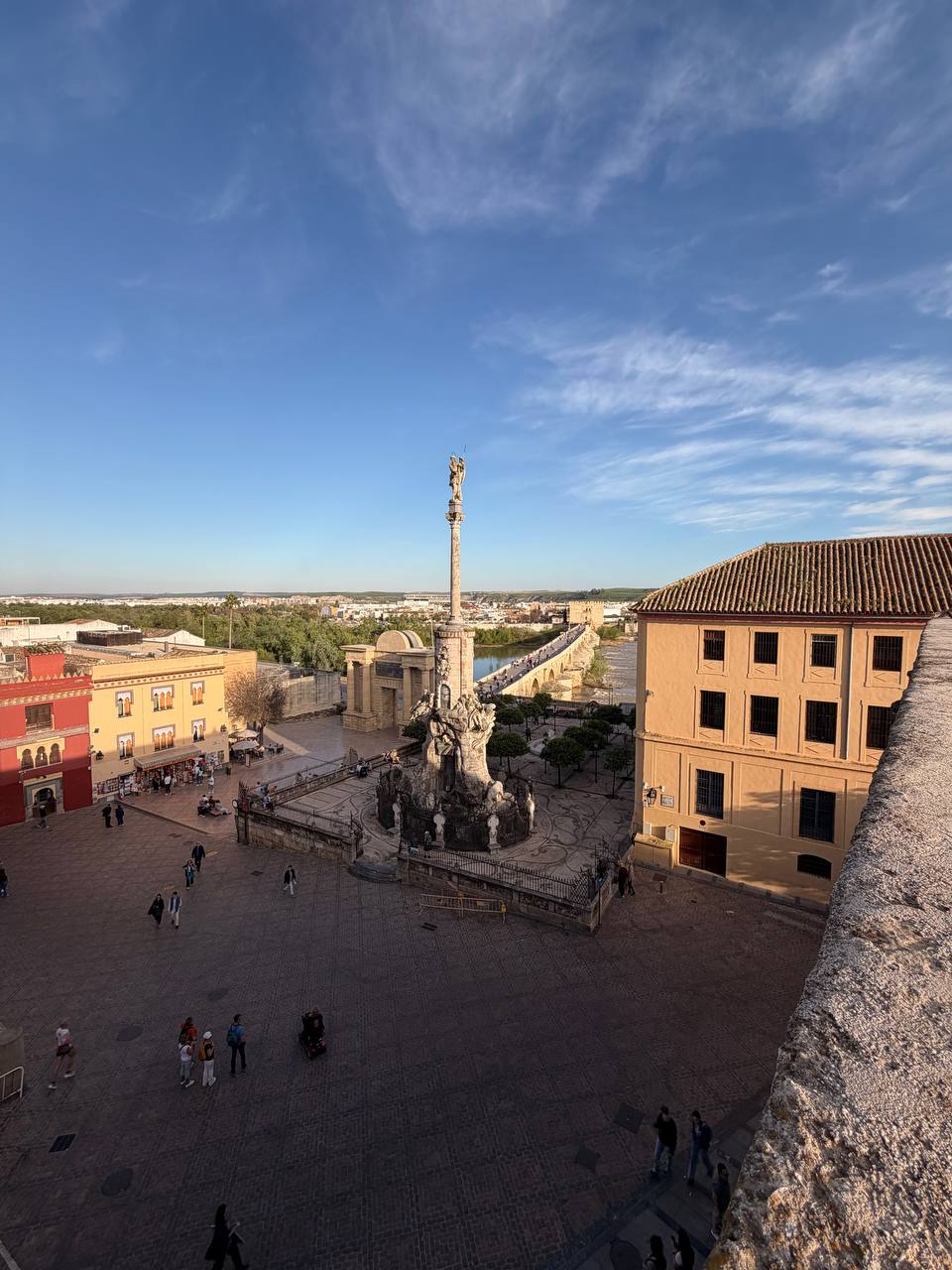
From the bridge you see it all at once: the Bridge Gate (16th century, Renaissance, built over an earlier Roman gate), the Triumph of Saint Raphael (patron of Córdoba, you'll see his columns all over the city), the noria — an Arab waterwheel that lifted water from the river to irrigate the Alcázar gardens. The original was so loud that Queen Isabella ordered it stopped because it kept her awake.
And behind it all, the Mezquita.
The Mezquita-Cathedral
Started in 785 by Abd al-Rahman I over a Visigothic church that had been a Roman temple before that. 856 columns of marble, jasper, and granite, recycled from Roman and Visigothic ruins. That's why they're all different: different heights, colors, materials. The double arches — one stacked on top of the other, red and white — were the ingenious solution to gain height with short columns.
The mihrab is the jewel. A prayer niche facing Mecca, decorated with gold Byzantine mosaics sent by the Emperor of Constantinople as a gift. When you get there, you look up and understand why people come from all over the world to see this.
In 1236 the Christians conquered Córdoba. In the 16th century they stuck a Renaissance cathedral inside the mosque. Literally inside it. Charles V authorized the construction and when he saw it finished said: "You have destroyed what was unique in the world." Even the one who approved it regretted it.
It's hard to explain what it feels like to walk among those columns. The forest of arches extends in every direction. Light enters filtered. Styles blend: Islamic, Roman, Renaissance, Baroque. Eight hundred years of history layered in a single space.
And then, the Patio de San Eulogio. A corner most people miss. Saint Eulogius was a 9th-century Córdoban priest, martyred during the Caliphate for defending Christians who refused to convert. Ironic that his patio sits inside what was the largest mosque in the Western world. The viewpoint above gives you a privileged view of the forest of columns and the Patio de los Naranjos. One of those places you find by accident that ends up being the best part.
Context
Córdoba was the largest city in Western Europe in the 10th century. Half a million inhabitants when Paris had twenty thousand. Capital of the Caliphate, center of knowledge, where Muslims, Jews, and Christians coexisted — with all the nuances that word implies.
Maimonides was a Jew in an Islamic city. Averroes, the Arab philosopher who reintroduced Aristotle to Europe, was born here. Seneca, the Roman Stoic, too. Three civilizations, one city.
All of that fits in an afternoon if you walk fast. But what stays with you isn't the monuments. It's the feeling of standing in a place where centuries of thought, conflict, art, and faith accumulated, layer upon layer, like the recycled columns of the Mezquita.
Tomorrow I head back to Madrid. But this afternoon in Córdoba was worth the entire trip.
— Jassu · Córdoba, March 2026
Llegué a Córdoba con una hora de retraso, una mochila, un carry-on y medio plan. El tren desde Granada se demoró, como se demoran las cosas en el sur de España: sin prisa, sin explicación, sin que a nadie le importe demasiado.
No importaba. Tenía una tarde.
La Judería
Lo primero fue la Sinagoga. Una de las tres sinagogas medievales que quedan en pie en toda España. Es chica, una sola sala, pero cuando pensás en lo que significa que siga ahí después de la expulsión de 1492, del tiempo, de todo, el tamaño deja de importar.
A metros, la estatua de Maimónides. Moshé ben Maimón, nacido en Córdoba en 1138. Médico, filósofo, rabino. Escribió la "Guía de los Perplejos", fue médico personal de Saladino en Egipto. Uno de los pensadores más importantes de la historia judía, nacido en estas calles.
La Calleja de las Flores es un callejón de tres metros de ancho con macetas. Se recorre en treinta segundos. La gracia es la foto: la calle estrecha, las flores, y la torre de la Mezquita asomando al fondo. Es lo que es.
El Puente Romano
331 metros sobre el Guadalquivir. Construido en el siglo I antes de Cristo. Tiene dos mil años. Lo cruzaron legiones romanas, ejércitos árabes, reyes cristianos.
Guadalquivir viene del árabe "al-wadi al-kabir" — el río grande. El mismo que pasa por Sevilla y termina en el Atlántico.
Desde el puente se ve todo junto: la Puerta del Puente (siglo XVI, renacentista, sobre una puerta romana anterior), el Triunfo de San Rafael (patrón de Córdoba, vas a ver columnas suyas por toda la ciudad), la noria — una rueda hidráulica árabe que levantaba agua del río para regar los jardines del Alcázar. La original hacía tanto ruido que la reina Isabel la Católica mandó a pararla porque no la dejaba dormir.
Y atrás de todo, la Mezquita.
La Mezquita-Catedral
Empezada en el 785 por Abderramán I sobre una iglesia visigoda que antes fue un templo romano. 856 columnas de mármol, jaspe y granito, recicladas de ruinas romanas y visigodas. Por eso son todas diferentes: distintas alturas, colores, materiales. Los arcos dobles — uno sobre otro, rojos y blancos — fueron la solución ingeniosa para ganar altura con columnas cortas.
El mihrab es la joya. Un nicho de oración orientado a La Meca, decorado con mosaicos bizantinos de oro que envió el emperador de Constantinopla como regalo. Cuando llegás ahí, mirás para arriba y entendés por qué la gente viene de todo el mundo a ver esto.
En 1236 los cristianos conquistan Córdoba. En el siglo XVI le meten una catedral renacentista adentro de la mezquita. Literalmente adentro. Carlos V autorizó la obra y cuando la vio terminada dijo: "Habéis destruido lo que era único en el mundo." Hasta el que la aprobó se arrepintió.
Es difícil explicar lo que se siente al caminar entre esas columnas. El bosque de arcos se extiende en todas las direcciones. La luz entra filtrada. Los estilos se mezclan: islámico, romano, renacentista, barroco. Ochocientos años de historia superpuestos en un mismo espacio.
Y después, el Patio de San Eulogio. Un rincón que la mayoría se pierde. San Eulogio fue un sacerdote cordobés del siglo IX, martirizado durante el Califato por defender a los cristianos que se negaban a convertirse. Irónico que su patio esté dentro de lo que fue la mezquita más grande de Occidente. El mirador de arriba te da una vista privilegiada del bosque de columnas y del Patio de los Naranjos. De esos lugares que encontrás por accidente y terminan siendo lo mejor.
Contexto
Córdoba fue la ciudad más grande de Europa occidental en el siglo X. Medio millón de habitantes cuando París tenía veinte mil. Capital del Califato, centro de conocimiento, donde convivían — con todos los matices que esa palabra implica — musulmanes, judíos y cristianos.
Maimónides era judío en una ciudad islámica. Averroes, el filósofo árabe que reintrodujo a Aristóteles en Europa, nació acá. Séneca, el estoico romano, también. Tres civilizaciones, una ciudad.
Todo eso cabe en una tarde si caminás rápido. Pero lo que queda no son los monumentos. Es la sensación de estar parado en un lugar donde se acumularon siglos de pensamiento, conflicto, arte y fe, capa sobre capa, como las columnas recicladas de la Mezquita.
Mañana me vuelvo a Madrid. Pero esta tarde en Córdoba valió el viaje entero.
— Jassu · Córdoba, marzo 2026